Cyrisin Inc. was founded
Cyrisin Inc. (Cyrisin株式会社) was incorporated in Fukuoka, Japan. The company researches, develops, designs and sells optical systems and optical modules for VR, AR and MR.
XR Optics
Cyrisin is a fabless developer of optical modules for VR headsets. Existing optics force a physical trade-off — go thinner and the field of view narrows. We break that trade-off with the structure of the lens itself.
WHAT MASO CAN REACH THEORETICAL
2mm
Optical system thickness
180°
Field of view
The thinness of sunglasses. The whole of human vision.
Technology
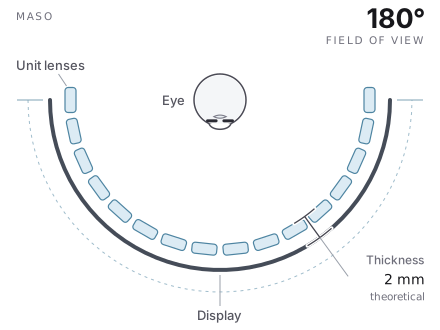
Existing VR optics place a single large lens in front of the eye. A wider field of view demands a larger lens, and a larger lens cannot reach a short focal length. That physical trade-off is why existing systems cannot be extremely thin and wide-view at once.
MASO instead arranges many very small unit lenses and superimposes the virtual image each one forms. Field of view follows the total area the lenses cover; thinness follows how small a single lens is — so the two can be designed independently. The trade-off itself disappears.
In the figures below, optical thickness means the distance from the eye-side surface of the eyepiece to the surface of the display.

Split the lens and you would expect to see the seams. You do not. When the gap between the lenses is smaller than the pupil diameter, what Lens 1 shows and what Lens 2 shows overlap on the retina. The gap between the lenses therefore cannot be seen. This happens because the eye does not look out through a point: the pupil gives it width.

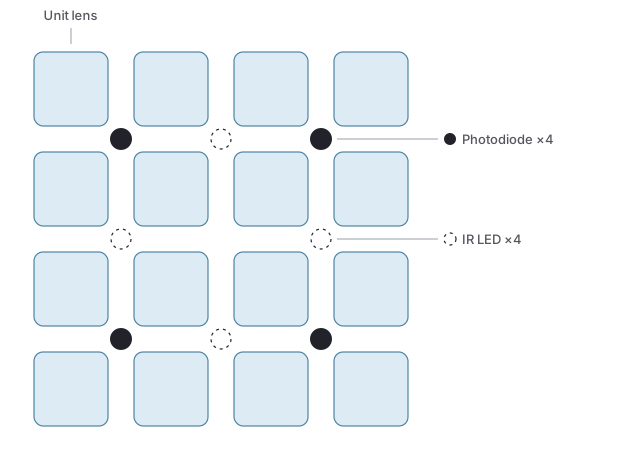
And a gap that disappears is a gap you can build into. A sensor placed directly in front of the eye sees the pupil as a perfect circle, which makes gaze calculation straightforward and accurate. In existing HMDs such a sensor would sit in the user's field of view, so it gets pushed to an oblique angle. MASO puts it head-on. Fresnel and pancake optics have no such gap, in principle.
MEASURED ON THE PROTOTYPE SID DISPLAY WEEK 2026
Thickness
14.6mm
Optical system thickness
Field of view
179°
139° horizontal / 79° vertical per eye
Integrated
4+4
Photodiodes and IR LEDs in the inter-lens gaps
The field of view is already on par with human vision. Thickness is what remains — and thickness is where MASO has room.
Pancake lenses run about 20 mm thick with roughly a 100° field of view. The MASO prototype already reached 14.6 mm and 179°, past them on both. And because the smaller the unit lens, the thinner the optics, the structure scales down to an optical thickness below 2 mm.
Pancake lenses fold the optical path with polarisation and reflection, which makes light efficiency above 25% fundamentally difficult. MASO delivers high light efficiency, so a lower display luminance suffices — and lower power consumption is expected to follow.
A sensor placed directly in front of the eye sees the pupil as a perfect circle, which makes gaze calculation straightforward and accurate. In existing HMDs such a sensor would sit in the user's field of view, so it is pushed to an oblique angle instead. MASO puts the sensor head-on, inside the lens gaps.
The prototype's unit lenses were commercially available PMMA biconvex lenses cut into 7 mm squares — unit lenses, an elemental image array and a housing, and little else. We keep design and intellectual property in house and leave manufacturing to specialist partners — a fabless model.
Research background
MASO builds on near-eye display optics research carried out at the Hattori Laboratory, Interdisciplinary Graduate School of Engineering Sciences, Kyushu University. Kento Matsuo, our founder and CEO, developed this optical system there and founded Cyrisin to bring it to production. The papers are co-authored with members of the laboratory.
Publication
K. Matsuo et al., “Multi-Aperture Superposition Optics for Compact VR: Enabling Wide Field of View and Sensor Integration,” SID Symposium Digest of Technical Papers, vol. 57, no. 1, pp. 66–69, 2026. Invited Paper 4-4 · SID Display Week 2026 · Interdisciplinary Graduate School of Engineering Sciences, Kyushu University
News
Cyrisin Inc. (Cyrisin株式会社) was incorporated in Fukuoka, Japan. The company researches, develops, designs and sells optical systems and optical modules for VR, AR and MR.
Charbax (Nicolas Charbonnier), long known for covering the display industry's trade shows, interviewed us at our I-Zone technology demo at SID Display Week 2026. The video walks through the structure of the prototype HMD and how eye-tracking sensors fit into the gaps between the lenses.
Watch the interview on YouTube (Charbax channel, external site)
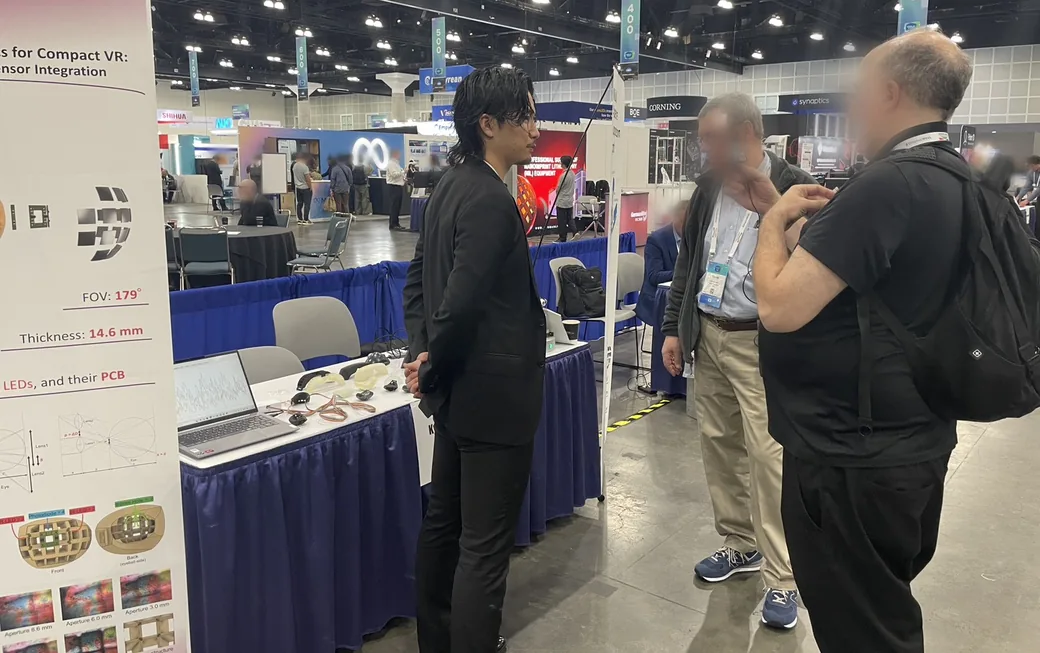
We exhibited a working MASO prototype HMD at the I-Zone (Innovation Zone) of SID Display Week 2026, held 3–8 May 2026 at the Los Angeles Convention Center, across the three days of the exhibition (5–7 May). Many visitors tried the prototype first-hand and gave us invaluable feedback.
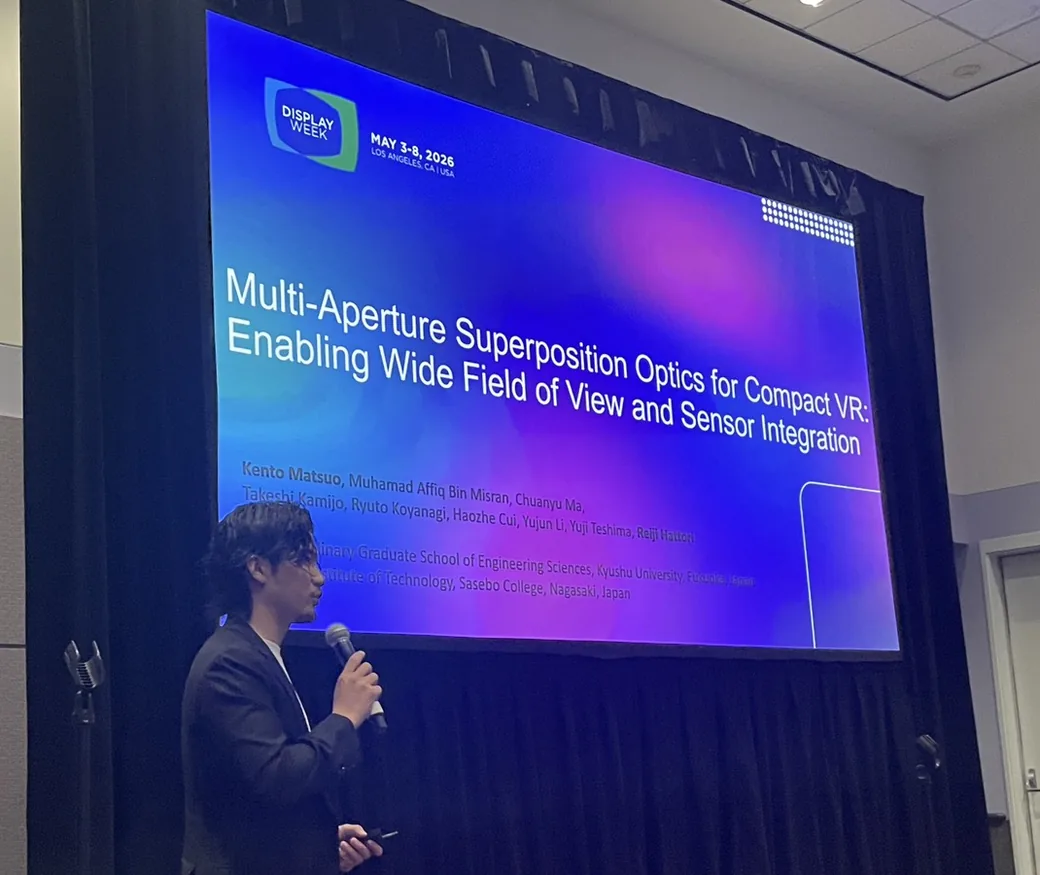
Kento Matsuo, our founder and CEO, gave an oral presentation titled “Multi-Aperture Superposition Optics for Compact VR: Enabling Wide Field of View and Sensor Integration” in the technical symposium (Session 4-4, Invited Paper). The paper appears in SID Symposium Digest of Technical Papers, vol. 57, no. 1, pp. 66–69, 2026.
Contact
For joint development, sample evaluation or press enquiries, reach us by email or on LinkedIn.
Office
7F T&J Building, 2-2-12 Tenjin,
Chuo-ku, Fukuoka 810-0001,
Japan
Company
Cyrisin Inc.
Kento Matsuo, Founder & CEO
Company profile →